Israeli Warplanes Strike Lebanon’s Southern Suburbs; Air Raid Sirens Sound Across Bahrain
The Middle East conflict intensifies as Israeli warplanes strike southern Beirut suburbs linked to Hezbollah, while air raid sirens echo across Bahrain amid fears of Iranian retaliation. The escalating US-Israel-Iran war is raising concerns of a wider regional conflict.
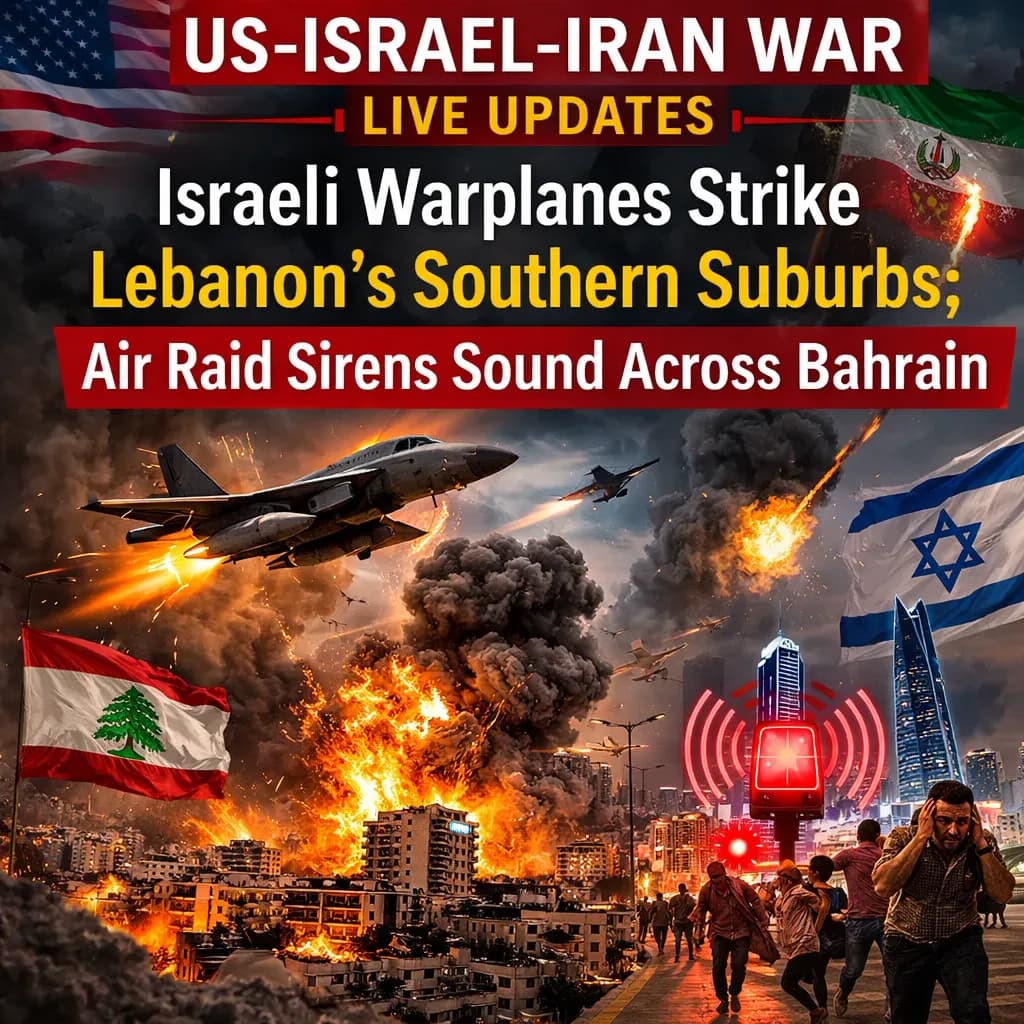
The ongoing conflict involving the United States, Israel, and Iran has entered a dangerous new phase as Israeli warplanes carried out fresh airstrikes on the southern suburbs of Beirut in Lebanon, intensifying a war that is rapidly spreading across the Middle East. The strikes targeted areas believed to be strongholds of Hezbollah, the Iran-backed militant group that has joined the confrontation against Israel. Witnesses reported powerful explosions and thick smoke rising over parts of southern Beirut, while emergency teams rushed to damaged residential neighborhoods where buildings were hit during the overnight bombardment. The escalation comes as Israel continues a broader campaign of strikes against Iranian-linked targets in Lebanon and Iran, part of a conflict that began in late February with coordinated U.S.–Israeli military operations.
At the same time, tensions spread further across the Gulf region when air-raid sirens sounded in Bahrain, forcing residents to seek shelter amid fears of incoming missiles or drones. Gulf states have been on high alert as Iran and its allied groups retaliate for the earlier strikes with missile and drone attacks targeting Israel and strategic infrastructure across the region. Several countries, including Bahrain and the United Arab Emirates, reported interception of drones and missiles, highlighting how the conflict is now affecting multiple nations far beyond the original battlefield.
The broader regional crisis has already caused heavy casualties and mass displacement, particularly in Lebanon where hundreds of people have reportedly been killed and hundreds of thousands forced to flee their homes due to continuous bombardment. Parts of Beirut and southern Lebanese towns have suffered severe destruction, while humanitarian organizations warn that civilian infrastructure and emergency services are under immense strain. Analysts say the conflict risks turning into a prolonged regional war, with Hezbollah launching rockets toward Israel and Iran continuing missile and drone attacks in response to the U.S.-Israeli campaign.
Meanwhile, global leaders are calling for urgent diplomatic efforts to prevent further escalation. The conflict has already disrupted global energy markets and shipping routes, particularly around the Strait of Hormuz, a key corridor for the world’s oil supply. As the war enters its third week, international observers warn that continued military exchanges between Israel, Iran, and their allies could draw more countries into the crisis and deepen instability across the Middle East.